Bed management
Track beds, locations, admissions, discharge states, and live availability across hospital hierarchies.
CARE HMIS is an open-source Hospital Information System that connects patient flow, information flow, and revenue flow across outpatient, emergency, inpatient, labs, pharmacy, billing, and reporting workflows.
100+
hospitals
5
deployment states
FHIR R5
standards-first core
MIT
open-source licence
CARE HMIS is built for hospitals that need more than a digital file. It combines EMR, HMIS, hospital operations, revenue cycle workflows, interoperability, and AI-ready clinical data in one reusable open platform.
HIS layer
Patients, encounters, notes, diagnoses, orders, observations, medications, care plans, and discharge summaries.
HIS layer
Appointments, queues, beds, wards, departments, staff roles, stock movement, reports, and dashboards.
HIS layer
Charge capture, invoices, payments, scheme coverage, claims direction, reconciliation, and accounting integration.
HIS layer
FHIR-aligned APIs, terminology bindings, ABDM workflows, device integrations, and plugin-based extensions.
The goal is not electronic records. It is a hospital that can coordinate care, measure quality, manage resources, and safely use assistive AI.
Registration, labs, medications, discharge, and billing live as separate events instead of one care story.
Orders, results, prescriptions, stock, and dispensing move through silos with no single operational flow.
Forms were digitized without redesigning the work around them, so software becomes one more burden.
Unbilled services, missed charges, and manual invoicing leave money on the table every day.
CARE HMIS treats a hospital as a living system. Every patient event, clinical decision, and financial transaction can move through one connected operating layer.
Registration, appointments, OPD, emergency, IPD, ICU, discharge, and follow-up.
Encounters, orders, results, records, decisions, and longitudinal clinical context.
Charges, invoices, scheme coverage, payments, and reconciliation as care is delivered.
CARE supports the full patient journey, while keeping clinical documentation consistent across hospitals, clinics, homes, and virtual visits.
Clinical visits linked to the patient record.
Priority care and emergency workflows.
Admissions, rounds, orders, notes, and discharge.
Short-stay monitoring with continuity.
Mobile documentation and care plans.
Remote consultation with structured records.
Modules are not isolated applications. They share patients, encounters, orders, observations, roles, reports, and audit trails.
Structured forms, symptoms, conditions, orders, medication requests, and observations.
Appointment calendars, public facility pages, doctor availability, and open slots.
Doctor, department, pharmacy, billing, and custom service queues for high-volume settings.
Configurable department forms mapped to interoperable clinical resources.
Live locations, beds, admission status, hierarchy, and availability.
Facility, district, state, program, and national structures with data segregation.
Granular role-based access control for doctors, nurses, admins, and health workers.
Treatment summaries, discharge summaries, dashboards, and custom operational reports.
These are not static module names. CARE HMIS supports live workflows across bed management, clinical drawings, and dynamic reporting on the same shared patient and facility data layer.
Track beds, locations, admissions, discharge states, and live availability across hospital hierarchies.
Capture drawings, body maps, annotations, and visual clinical context directly in the patient record.
Generate operational and clinical reports from shared encounters, forms, orders, and care activity.
CARE HMIS gives hospitals a shared information system for clinical, administrative, operational, and financial work. Each department can keep its workflow while contributing to one longitudinal record.
Registration, demographics, patient search, appointments, queues, and visit creation.
Consultations, notes, prescriptions, investigations, follow-up, referrals, and summaries.
Rapid registration, triage direction, emergency encounters, orders, observation, and handover.
Admissions, bed allocation, rounds, nursing updates, orders, discharge, and transfers.
TeleICU extension, vitals/device direction, remote review, video, and escalation workflows.
Lab orders, specimen tracking direction, results, diagnostic reports, and LOINC/UCUM alignment.
Prescriptions, dispensing, substitutions, stock alerts, procurement, inventory, and audit trails.
Service charges, invoices, payments, insurance/scheme support, and reconciliation workflows.
Facilities, departments, users, roles, access control, audit logs, reports, and operational analytics.
Labs, pharmacy, stock, billing, and accounting are not downstream admin tasks. They are part of the same clinical timeline.
Clinicians order tests, labs track samples, results attach to the record, and observations use standard codes and units.
Prescriptions flow into dispensing, substitutions, stock movement, alerts, procurement, and supply chain workflows.
Cash, insurance, government schemes, invoices, payment capture, and reconciliation connect back to care activity.
CARE HMIS is standards-first, API-first, modular, cloud agnostic, mobile-first, and designed to be extended without forking the core.
FHIR R5
clinical resources and APIs
SNOMED CT
clinical terminology
LOINC
labs and observations
UCUM
units of measure
ICD-10
classification support
BYOT
bring your own terminology
CARE Apps add national rails, TeleICU, AI documentation, devices, claims, token display, messaging, and analytics through a plugin layer. AI drafts. Humans decide. CARE records.
M1, M2, M3 and identity workflows through plugins.
Camera, vitals, remote review, and critical care extension.
Multilingual voice fill and assistive documentation.
Queue and token screens for TVs and public counters.
Orders, results, PACS, and bedside integrations.
HCX, reminders, analytics, and patient communication.
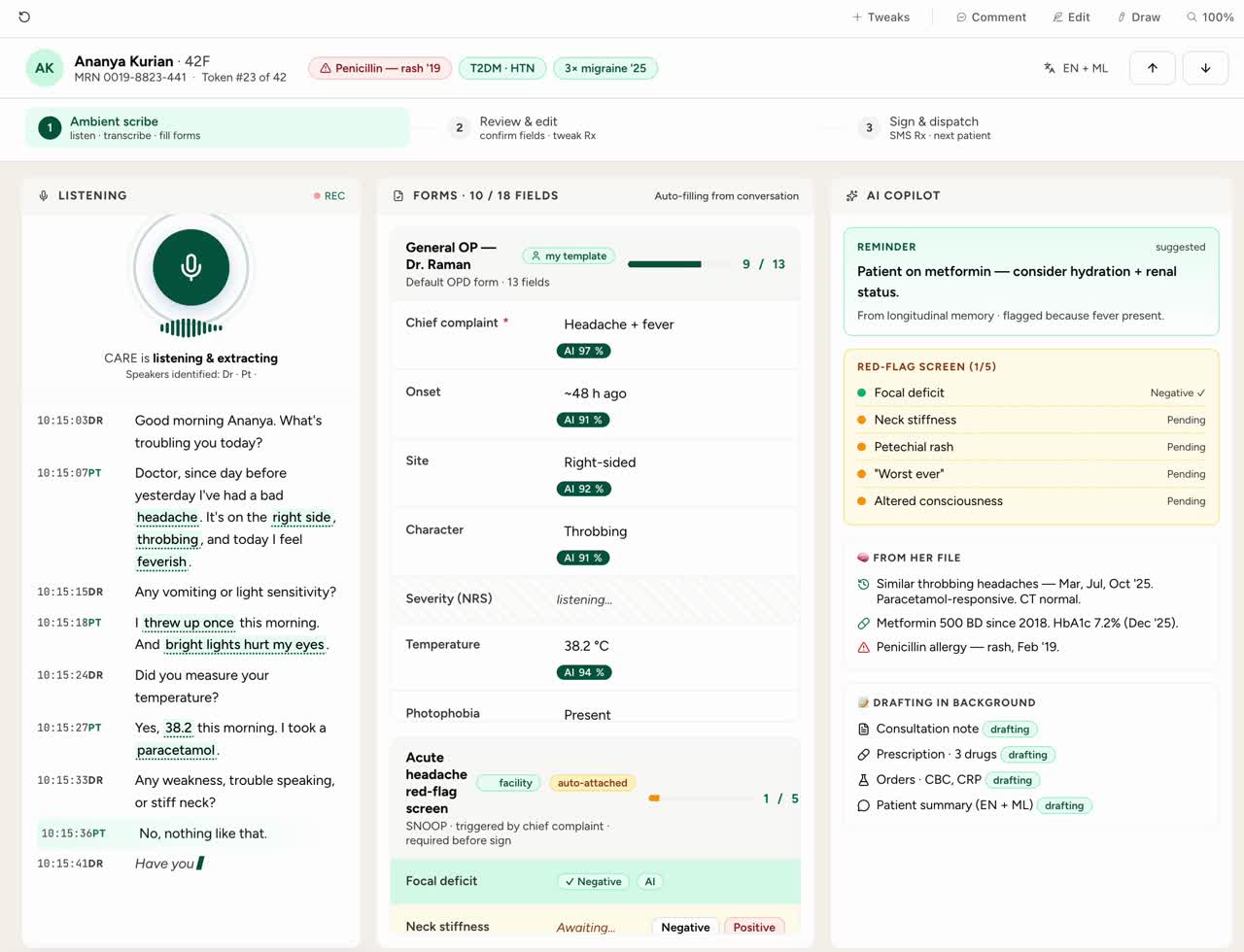
Responsible AI
Voice fill, document understanding, record summaries, discharge drafts, and decision support sit on top of structured clinical data with human review.
CARE HMIS deployments can start with a focused hospital workflow and expand into a complete Hospital Information System. The same open core supports phased adoption, local configuration, partner-led implementation, and long-term release upgrades.
Facilities, departments, rooms, beds, services, staff, user roles, tariffs, and drug catalogues.
OPD, emergency, IPD, pharmacy, lab, billing, and discharge flows aligned to local practice.
Configurable EMR forms, FHIR resources, ValueSets, SNOMED CT, LOINC, UCUM, and ICD-10.
ABDM, devices, lab systems, accounting tools, messaging, analytics, payments, and partner plugins.
Role-based access, audit trails, hosting choices, data ownership, backup, and operational controls.
Training, phased rollout, support desk, reporting cadence, feedback loops, and release upgrades.
CARE HMIS 3.0 is now live across deployments in Kerala, Karnataka, Jharkhand, Assam, and Manipur, supporting 100+ hospitals through a reusable open-core model.
Kerala
live deployment
Karnataka
live deployment
Jharkhand
live deployment
Assam
live deployment
Manipur
live deployment
100+
hospitals
These answers are written for teams comparing open-source HIS, HMIS, EMR, and hospital management software options.
CARE HMIS is an open-source Hospital Information System and Hospital Management Information System built around CARE Core. It connects clinical records, hospital operations, billing, reporting, integrations, and AI-ready workflows on one standards-based platform.
CARE HMIS includes EMR capabilities, but it is broader than an electronic medical record. It supports patient registration, OPD, emergency, inpatient care, labs, pharmacy, inventory, billing, reporting, access control, integrations, and deployment workflows.
Yes. CARE is designed for self-hosted, cloud, hybrid, and on-premise deployment models, so hospitals and governments can own their infrastructure and avoid software licence lock-in.
CARE HMIS can support front desk, OPD, emergency, inpatient wards, ICU and TeleICU workflows, laboratory, pharmacy, inventory, billing, administration, analytics, and patient-facing workflows.
CARE HMIS is standards-first, with FHIR R5-aligned resources, open APIs, terminology support for SNOMED CT, LOINC, UCUM and ICD-10, and plugin-based integrations for national rails, devices, labs, claims, messaging, and analytics.
AI is assistive and human-in-the-loop. CARE HMIS can support voice fill, documentation drafts, document understanding, summaries, and decision-support workflows on top of structured clinical data and audit-aware processes.
CARE HMIS gives hospitals the shared operating layer for clinical work, operations, revenue, analytics, and carefully governed AI.